News
From research data to generative art
Through a unique collaboration between Paris Brain Institute researcher and team leader Fabrizio De Vico Fallani and the artist Florian Zumbrunn, brain data obtained from scientific research is being brought to life in the form of works of art. A fascinating juxtaposition where technology becomes a bridge between medical innovation and artistic creation.

Fabrizio: what is the aim of your research project and what data do you generate?
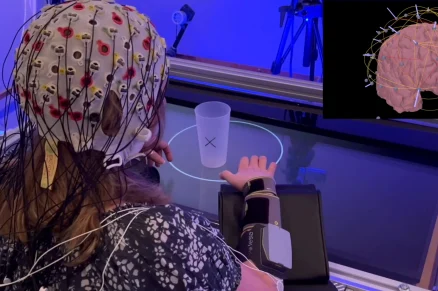
After a stroke, you may lose the ability to move but not the ability to imagine. When we imagine a movement, our brain generates the brain command associated with that movement. In recent years, we have developed at Paris Brain Institute a non-invasive machine-brain interface that is capable of detecting this brain command and transforming it into a tangible command. Our ambition is to use this technology to stimulate motor recovery in stroke patients. In other words, to restore effective communication between the brain and the paralyzed limb.
Can you explain how this non-invasive brain-machine interface works?
This interface uses electroencephalography (EEG) to record the electrical activity of neurons. We use electrodes placed on the scalp to capture these brain signals. We imagine these electrodes as different musical instruments. They interact with each other and generate different signals to create harmonious music. It is possible to transcribe all these signals in the form of numerical sequences that compose a sort of musical score of the brain.
So this data is essentially scientific. How did you come up with the idea of creating a bridge with art?
This idea took shape after meeting Florian. He showed me how data which we perceive as purely scientific could be reinterpreted to become something artistic.
“By transforming the data into a tangible and expressive work of art, Florian gives it a whole new dimension that is both emotional and aesthetic. His work doesn’t just represent the data, the data also tells a story of the connection between science and creativity, between the human brain and the artist’s hand.”
Fabrizio de Vico Fallani